Presentation of the Best Practice
Target challenge
- Environmental pollution
- Degradation of the Ecosystem (water stress)
- Vulnerability to climate Change
- Other (Please specify below)
- Green area degradation
Area Typology
- Urban area
- Other (Please specify below)
- Dense Urban
Main beneficiaries
- Local Population
- Municipalities
- Other (Please specify below)
- University community, including staff, students, attendees, etc.
Impact on the beneficiaries of your Best Practice:
The Polder Roof provides multiple benefits to its beneficiaries by combining urban flood mitigation, climate adaptation, and environmental co-benefits.
By temporarily storing and regulating rainwater during intense precipitation events, the system significantly contributes to urban flood risk reduction, particularly during extreme rainfall (IOR95 = 0.38). This controlled retention and delayed release of stormwater reduces peak runoff entering the drainage network, helping cities become more resilient to climate-induced extreme events.
Beyond flood mitigation, the Polder Roof enhances the quality of life for building users and the surrounding community. The vegetated roof improves urban aesthetics and biodiversity, creating green space in dense urban environments while supporting ecological functions. In addition, vegetation and substrate contribute to air quality improvement and help mitigate the urban heat island effect through evapotranspiration processes.
The system also delivers energy benefits for the building by increasing latent heat flux and evaporative cooling, which can reduce indoor temperatures and potentially lower energy demand for cooling.
Overall, the Polder Roof installed at the University of Cagliari demonstrates how innovative green infrastructure can simultaneously address stormwater management, climate resilience, environmental quality, and energy efficiency, generating tangible benefits for both urban residents and local ecosystems.
By temporarily storing and regulating rainwater during intense precipitation events, the system significantly contributes to urban flood risk reduction, particularly during extreme rainfall (IOR95 = 0.38). This controlled retention and delayed release of stormwater reduces peak runoff entering the drainage network, helping cities become more resilient to climate-induced extreme events.
Beyond flood mitigation, the Polder Roof enhances the quality of life for building users and the surrounding community. The vegetated roof improves urban aesthetics and biodiversity, creating green space in dense urban environments while supporting ecological functions. In addition, vegetation and substrate contribute to air quality improvement and help mitigate the urban heat island effect through evapotranspiration processes.
The system also delivers energy benefits for the building by increasing latent heat flux and evaporative cooling, which can reduce indoor temperatures and potentially lower energy demand for cooling.
Overall, the Polder Roof installed at the University of Cagliari demonstrates how innovative green infrastructure can simultaneously address stormwater management, climate resilience, environmental quality, and energy efficiency, generating tangible benefits for both urban residents and local ecosystems.
Funding
- EU funding
- National funding
Used technologies / tools
- Nature based process
- Soil infiltration
- Sustainable Drainage Systems
- Physical process
- Sedimentation
- Evaporation
- MBGR, Multilayer Blue – Green roof
- CAM, Acid metabolism
- HOBO, Thermometers
- CS650, Moisture sensor
- HIKVISION, Thermal camera
- OPTRIS, Pyrometer
Implementation site
Cagliari
NCW type
- Rainwater (RW)
NCW USE
- Garden Irrigation
Self-Assessment
TRL : Technology Levels
TRL7
Description of the innovative component:
The PolderRoof system represents an innovative approach that integrates water management, ecology, and architecture, transforming a conventional roof into a multifunctional blue-green infrastructure.
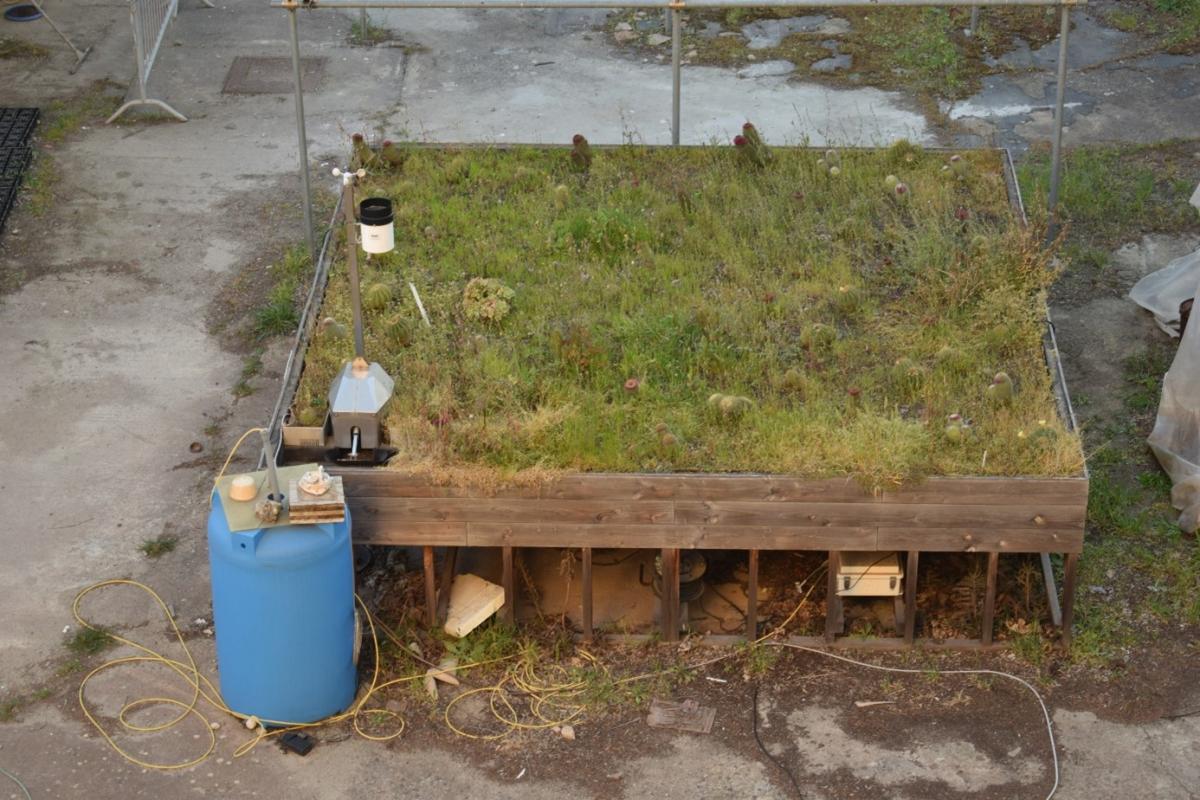
The innovation lies in the concept of a controlled-storage green roof, where a vegetated layer is combined with a regulated water storage system. The first Mediterranean prototype exemplifies this approach by integrating a green roof layer consisting of 8 cm of sandy soil planted with drought-resistant CAM cacti with a 10 cm controllable storage layer. This storage layer is equipped with a remote-controlled gate, which allows operators to regulate the amount of water retained or released from the roof. This capability is crucial for dynamically managing the available storage capacity, optimizing stormwater retention before rainfall events and enabling runoff capture, reuse, and improved hydrological performance.
Beyond stormwater management, the system simultaneously supports building insulation, urban biodiversity, and climate adaptation benefits, demonstrating how roof surfaces can be transformed into multifunctional urban infrastructure.
Another innovative component of the prototype is the advanced environmental monitoring system installed on the roof. This system includes four HOBO temperature sensors, soil moisture sensors (CS650 connected to a Drill Drop datalogger), thermal cameras, a pyrometer, and a Baro-Diver pressure sensor. These instruments allow continuous monitoring of thermal performance, soil moisture dynamics, and hydrological behaviour, providing high-resolution data to evaluate the roof’s performance under Mediterranean climate conditions and during extreme rainfall events.
Together, the controlled storage technology and integrated monitoring platform make the PolderRoof prototype a cutting-edge example of blue-green infrastructure, advancing research and practical implementation of climate-resilient urban water management systems.
The innovation lies in the concept of a controlled-storage green roof, where a vegetated layer is combined with a regulated water storage system. The first Mediterranean prototype exemplifies this approach by integrating a green roof layer consisting of 8 cm of sandy soil planted with drought-resistant CAM cacti with a 10 cm controllable storage layer. This storage layer is equipped with a remote-controlled gate, which allows operators to regulate the amount of water retained or released from the roof. This capability is crucial for dynamically managing the available storage capacity, optimizing stormwater retention before rainfall events and enabling runoff capture, reuse, and improved hydrological performance.
Beyond stormwater management, the system simultaneously supports building insulation, urban biodiversity, and climate adaptation benefits, demonstrating how roof surfaces can be transformed into multifunctional urban infrastructure.
Another innovative component of the prototype is the advanced environmental monitoring system installed on the roof. This system includes four HOBO temperature sensors, soil moisture sensors (CS650 connected to a Drill Drop datalogger), thermal cameras, a pyrometer, and a Baro-Diver pressure sensor. These instruments allow continuous monitoring of thermal performance, soil moisture dynamics, and hydrological behaviour, providing high-resolution data to evaluate the roof’s performance under Mediterranean climate conditions and during extreme rainfall events.
Together, the controlled storage technology and integrated monitoring platform make the PolderRoof prototype a cutting-edge example of blue-green infrastructure, advancing research and practical implementation of climate-resilient urban water management systems.
Obstacles to implementation
- High cost of technological solutions
Obstacles to funding
Installed as part of an EU project (no initial cost), but it requires funding for maintenance and upgrade.
How your Best Practice is economically feasible ?
Although the PolderRoof system has relatively high initial construction costs, it remains economically feasible thanks to the multiple benefits it provides over its lifetime.A key factor is the selection of drought-resistant CAM vegetation, which can survive with minimal water input. Combined with the controllable storage layer, this vegetation strategy allows plants to persist without intensive maintenance, effectively eliminating most long-term vegetation management costs. As a result, the system requires very limited operation and maintenance (O&M) compared with many conventional green roof solutions.
Operational costs are further reduced thanks to the automated control gate and minimal irrigation needs, which allow the roof to regulate stormwater storage and release without continuous manual intervention. At the same time, the system provides significant hydrological value by retaining and delaying stormwater runoff, thereby contributing to urban flood mitigation and reducing pressure on drainage infrastructure.
In addition, the presence of integrated filtration and storage capacity enables the reuse of retained rainwater for irrigation and other non-potable uses, generating water savings and further improving the economic performance of the system.
Overall, the combination of low maintenance requirements, water reuse opportunities, and the ecosystem services provided by stormwater retention helps offset the initial capital expenditure, making the PolderRoof a cost-effective solution over its operational lifetime.
Result of this assessment
No sustainability assessment has been carried outEnviromental impact
SDGs
Energy consumption KWh/m3
0.00
Energy consumption comment
To open &close the gate: 0.00025 kWh If the storage layer is full : 0.00020 kWh/m3
Validation/upscaling
Yes, the Best Practice has been validated through field monitoring and modelling, although it has not yet been physically upscaled and currently remains at the prototype stage.
The performance…
The performance…
Potentiel of exploitation/outscaling
Yes, there is strong potential for both replication and upscaling. The PolderRoof system developed by MetroPolder Company and tested at the University of Cagliari is based on modular and adaptable…
Lessons learnt
The intensive CAM green roof at the University of Cagliari has provided several valuable lessons from its design, implementation, and long-term monitoring. The spontaneous CAM vegetation (Agave…
Recommandations
To promote the wider adoption of green roofs, policy measures should combine financial incentives, public engagement, and regulatory integration. Providing subsidies, grants, or tax incentives,…
Highlighted KPI
Technical indicators
Average Treated flow rate
m3/Day
Suspended solids SS0 g/Day
COD0 g/Day
Economical indicators
Land footprint
10.67
m2/m3/day


Social impact of the BP
Jobs created
Jobs created comment: 3-4 researcher positions during several projects