
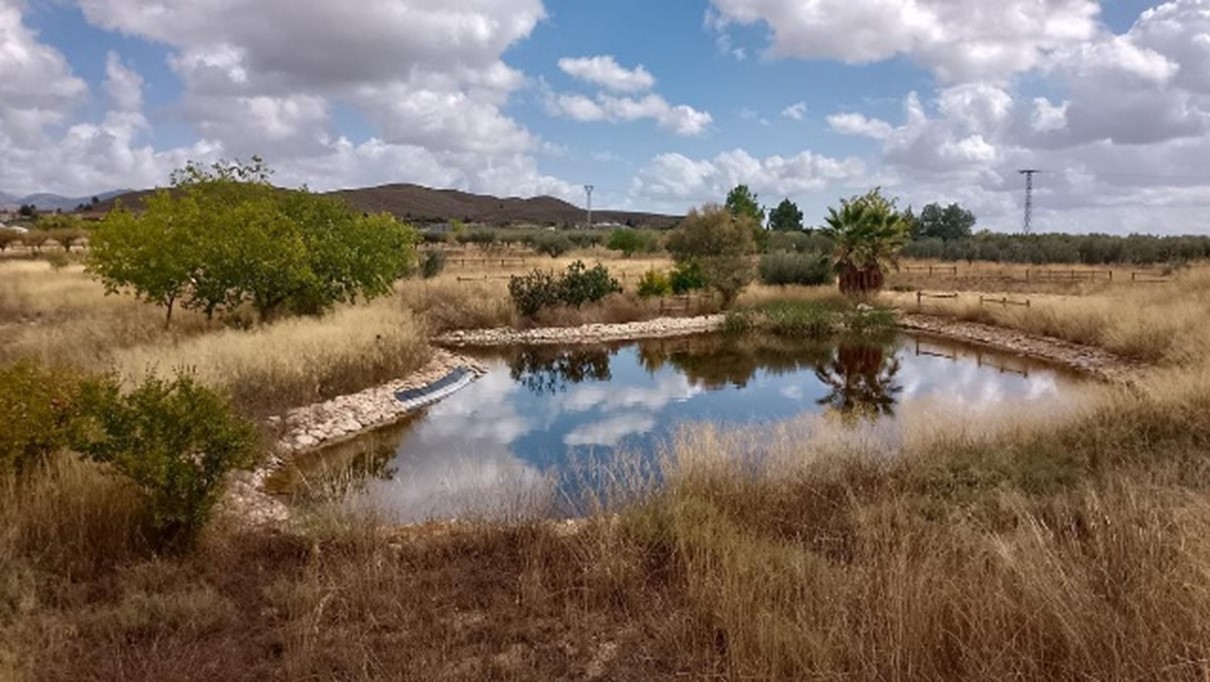
Presentation of the Best Practice
Target challenge
- Difficult access to water
- Environmental pollution
- Overexploited groundwater
- Degradation of the Ecosystem (water stress)
- Vulnerability to climate Change
- Other (Please specify below)
- This practice tackles water scarcity and uncontrolled runoff. Intercepting stormwater prevents downstream pollution. Storing and reusing rainwater for irrigation reduces runoff volume, limits erosion, and improves environmental quality .
Area Typology
- Urban area
- Agricultural area
- Other (Please specify below)
- Peri-Urban area, La Paca collects urban stormwater into perimeter reservoirs. This water is reused for irrigation by the Campo Alto Irrigators' Community, functionally integrating urban drainage with peri-urban agriculture.
Main beneficiaries
- Water Utilities
- Local Population
- Municipalities
- Management Authorities
- Other (Please specify below)
- Direct beneficiaries include Lorca Municipality, local residents, and Campo Alto's 307 irrigators managing 950 hectares. The system directly boosts agricultural water security, indirectly supporting local rural families' livelihoods.
Impact on the beneficiaries of your Best Practice:
The system directly benefits 307 irrigators managing 435 ha of agricultural land. By providing approximately 50,000 m³/year of complementary water resources from harvested stormwater, the Best Practice increases water availability, improves agricultural resilience during dry periods and reduces dependence on scarce conventional resources.
Together with subsequent investments in reclaimed-water reuse, storage infrastructure and renewable-energy solutions, the initiative contributes to maintaining agricultural activity, supporting rural employment, improving farm profitability and reducing the risk of rural depopulation in a semi-arid area with limited water availability.
Together with subsequent investments in reclaimed-water reuse, storage infrastructure and renewable-energy solutions, the initiative contributes to maintaining agricultural activity, supporting rural employment, improving farm profitability and reducing the risk of rural depopulation in a semi-arid area with limited water availability.
Funding
- EU funding
- National funding
Used technologies / tools
- Physical process
- Sedimentation
- Filtration
- Others
- stormwater inlets;
- transfer pipelines;
- drainage system;
- sedimentation and regulation ponds;
- irrigation-distribution infrastructure;
Implementation site
La Paca, Lorca, Region of Murcia
NCW type
- Rainwater (RW)
NCW USE
- Field irrigation
- Other (Please specify below)
Self-Assessment
TRL : Technology Levels
TRL9
Description of the innovative component:
The innovation lies in the integrated management of multiple non-conventional water resources within a water-scarce rural environment. The Best Practice combines urban stormwater harvesting, agricultural reuse and integration with existing irrigation infrastructure to create a reliable complementary water source for irrigated agriculture.
The approach forms part of a wider strategy that combines stormwater harvesting, reclaimed-water reuse, renewable-energy-powered pumping and storage infrastructure. This integrated model improves water security, reduces dependence on saline groundwater, lowers energy consumption, contributes to climate-change adaptation and supports the long-term viability of rural communities.
Its added value lies not in a single technology, but in the coordinated management of alternative water resources to increase resilience, maintain agricultural activity and help reduce the risk of rural depopulation
The approach forms part of a wider strategy that combines stormwater harvesting, reclaimed-water reuse, renewable-energy-powered pumping and storage infrastructure. This integrated model improves water security, reduces dependence on saline groundwater, lowers energy consumption, contributes to climate-change adaptation and supports the long-term viability of rural communities.
Its added value lies not in a single technology, but in the coordinated management of alternative water resources to increase resilience, maintain agricultural activity and help reduce the risk of rural depopulation
Obstacles to implementation
- Other (Please specify below)
- Water scarcity and salinity threaten farming viability, risking land abandonment and rural depopulation. This practice improves water security, supporting livelihoods and climate resilience through urban stormwater harvesting and reuse.
Obstacles to funding
Funding applications required demonstrating that stormwater harvesting could simultaneously contribute to water security, climate-change adaptation, agricultural competitiveness and rural-development objectives in a small water-scarce rural community. The challenge consisted mainly of justifying the long-term environmental and socio-economic benefits of the proposed infrastructure.
How your Best Practice is economically feasible ?
The Best Practice is economically feasible because it uses existing stormwater collection infrastructure to capture rainwater at very low operational cost. The collected runoff is conveyed to the agricultural reservoir of La Paca, providing farmers with an additional water source without the need for energy intensive treatment processes. The initial investment was financed through public regional and municipal funds, and the operation and maintenance costs are minimal and covered by the municipality and the local irrigation community. By reducing dependence on groundwater and external water supplies, the system lowers irrigation costs and increases long term water security for the agricultural sector.Result of this assessment
No formal sustainability assessment has been carried out. Qualitative evidence suggests that the system contributes to additional irrigation-water availability, reduced stormwater runoff, improved drought resilience and reduced pressure on groundwater resources. However, no quantified assessment of environmental, social or economic impacts is currently available.Enviromental impact
SDGs
Energy consumption comment
NA. Site-specific monitoring data are not available
Validation/upscaling
The system has been operating since the implementation of the original stormwater-harvesting scheme and was subsequently expanded to increase collection capacity. Operational information indicates…
Potentiel of exploitation/outscaling
Replication is feasible in rural and peri-urban areas where sufficient stormwater runoff can be collected, storage capacity is available or can be developed, agricultural demand exists in proximity…
Lessons learnt
Integrating stormwater collection with agricultural reuse can be effective in water-scarce settlements. Close coordination among the municipality, regional water authorities and irrigators’ community…
Recommandations
Promote adaptation of existing stormwater networks where hydrology, storage and agricultural demand are suitable. Undertake catchment and water-quality assessment; define water rights and operating…
Highlighted KPI
Technical indicators
Average Treated flow rate
m3/Day
Economical indicators
Average total Cost
euro/m3 terated/day
Without consideration of the depreciation period
Land footprint
240000.00
m2/m3/day
Social indicators
More Informations
- https://www.chsegura.es/es/
- https://www.murcia.com/region/noticias/2021/12/23-la-comunidad-amplia-el-sistema-de-captacion-de-pluviales-para-su-reutilizacion-por-la-comunidad-de-regantes-campo-alto-de-lorca.asp
- https://www.laopiniondemurcia.es/municipios/2023/08/21/campo-alto-comunidad-regantes-comprometida-91119653.html
Contact
Send mailShare Everywhere


Social impact of the BP
- Preservation of living environment
- Improvment of health conditions
- Sustaining natural ecosystems
- Other (Please specify below)
Strengthening rural community resilience through improved water securityJobs created
Jobs created comment: Approximately 10–15 temporary jobs during construction, with 1–2 jobs indirectly maintained through annual inspection and maintenance. Agricultural water security may also help preserve local farming employment.